【LeetCode 363】Max Sum of Rectangle No Larger Than K

[LeetCode 363] Max Sum of Rectangle No Larger Than K

Problem description:

Given a non-empty 2D matrix matrix and an integer k, find the max sum of a rectangle in the matrix such that its sum is no larger than k.

Note:
The input is an array of integers. Only the least significant 8 bits of each integer is used to store the data. This means each integer represents only 1 byte of data.

Example1:

1
2
3
4
5
Given matrix = [
[1, 0, 1],
[0, -2, 3]
]
k = 2

The answer is 2. Because the sum of rectangle [[0, 1], [-2, 3]] is 2 and 2 is the max number no larger than k (k = 2).

Note:

  1. The rectangle inside the matrix must have an area > 0.
  2. What if the number of rows is much larger than the number of columns?

问题描述:

给定一个非空的二位矩阵和一个整数K,找到矩阵中子矩阵和最大并且不超过k的最大值。

示例1:

1
2
3
4
5
给定矩阵 matrix = [
[1, 0, 1],
[0, -2, 3]
]
k = 2

答案是2,因为矩形[[0, 1], [-2, 3]]和是2并且2 是不超过k(k=2)的最大值 。

Solution1:

这道题用纯暴力只能过95%左右,后面几个用例都会超时,所以在暴力的基础上稍微改进一下即可通过。(但不是最优解,复杂度为O(N2M2))

用一个新矩阵保存计算值,每个值表示从点(0,0)到(i,j)的和,则计算(x1,y1)到(x2,y2)的值有以下四种情况:

  • x1-1<0 && y1-1<0: 说明(x1,y1)即为(0,0)点,直接返回存储矩阵中s[x2][y2]的值
  • x1-1>=0 && y1-1<0: 说明y1=0,

    1
    2
    3
    4
    5
    6
    1 2 3 4
    -------
    5 6 7 8
    0 1 2 9
    -------
    计算从(1,0)到(3,3)的值

    则返回s[x2][y2]-s[x1-1][y2]

  • x1-1<0 &&="" y1-1="">=0: 说明x1=0,

    1
    2
    3
    4
    5
    1|2 3 4|
    5|6 7 8|
    0|1 2 9|

    计算从(0,1)到(3,3)的值

则返回s[x2][y2]-s[x2][y1-1]

  • x1-1>=0 && y1-1>=0:

    1
    2
    3
    4
    5
    1 2 3 4
    -------
    5|6 7 8|
    0|1 2 9|
    -------

则返回s[x2][y2]-(s[x1-1][y2]+s[x2][y1-1]-s[x1-1][y1-1])

遍历子矩阵用四层循环即可解决。

Code:

1
2
3
4
5
6
7
8
9
10
11
12
13
14
15
16
17
18
19
20
21
22
23
24
25
26
27
28
29
30
31
32
33
34
35
36
37
38
39
40
41
42
43
44
45
46
47
48
49
50
51
52
53
54
55
56
57
58
59
60
61
62
63
64
65
66
67
class Solution {
public int maxSumSubmatrix(int[][] matrix, int k) {


int max=0;
int row=matrix.length;
int col=matrix[0].length;

int [][]store=new int[row][col];
for(int i=0;i<row;i++){
for(int j=0;j<col;j++){
store[i][j]=sum(matrix,0,0,i,j);
}
}


boolean flag=true;
for(int x=0;x<row;x++){
for(int y=0;y<col;y++){
for(int i=x;i<row;i++){
for(int j=y;j<col;j++){

int t=sSum(store,x,y,i,j);
if(t==k)
return t;
if(flag && t<k){
max=t;
flag=false;
}
if(t<k){
max=Math.max(t,max);

}
}


}

}
}
return max;

}

public int sSum(int [][]s,int x1,int y1,int x2,int y2 ){
if(x1-1<0 && y1-1<0)
return s[x2][y2];
if(x1-1>=0 && y1-1<0)
return s[x2][y2]-s[x1-1][y2];
if(x1-1<0 && y1-1>=0)
return s[x2][y2]-s[x2][y1-1];
else{
return s[x2][y2]-(s[x1-1][y2]+s[x2][y1-1]-s[x1-1][y1-1]);
}
}
public int sum(int [][]matrix,int x1,int y1,int x2,int y2){
int res=0;
for(int i=x1;i<=x2;i++){
for(int j=y1;j<=y2;j++){
res+=matrix[i][j];
}

}
return res;

}
}

Solution2:动态递归解法(学习后补充)

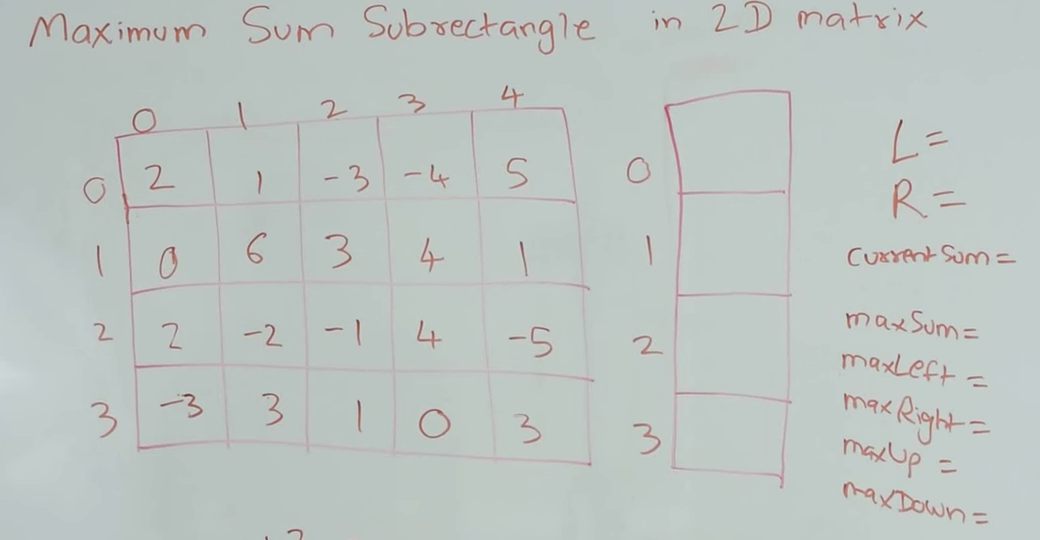
首先使用动态规划解法,这道题目可以拆分成两道题。
第一点是求矩阵子矩阵最大和的动态规划思想,参考视频链接

具体思想就是,按列扫描累加每一列然后求最大值,这样就转换为一维数组子数组求最大和的问题,这是一个简单的动态规划,dp[i]=max(dp[i-1],array[i]);

第二点就是一维数组子数组最大和有可能大于给定的k,所以问题转换为求一维数组子数组和不大于k的最大值:

通过累加和可以求得任意区间的和,例如,cum数组为累加和数组,cum[i]表示从cum[0]到cum[i]的和,则区间(i,j)的和可表示为cum[j]-cum[i-1];

这里还要借助TreeSet因为treeset中ceiling方法可以求出大于或等于给定的元素的最小元素,也就是说我们在累加过程中去比较max和set.ceiling(sum-k)的大小即可,由于treeset查询这一步时间复杂度是O(logn),所以总的时间复杂度是O(N2*M*log(M)),如果列数远远大于行数,可以按照行扫描。

Code:

1
2
3
4
5
6
7
8
9
10
11
12
13
14
15
16
17
18
19
20
21
22
23
24
25
26
27
28
29
30
31
32
33
34
35
36
37
38
39
40
41
42
43
44
45
46
47
48
49
50
51
52
53
class Solution {
public int maxSumSubmatrix(int[][] matrix, int k) {
int rowSize=matrix.length;
int colSize=matrix[0].length;
int maxSum=Integer.MIN_VALUE;
int currentSum=0;

// int maxLeft=0;
// int maxRight=0;
// int maxUp=0;
// int maxDown=0;

int []rowArray=new int[rowSize];
for(int left=0;left<colSize;left++){
for(int right=left;right<colSize;right++){
for(int i=0;i<rowSize;i++){
rowArray[i]+=matrix[i][right];
}


currentSum=maxSubArray(rowArray,k);

if(currentSum==k)
return k;

if(currentSum<k)
maxSum=Math.max(currentSum,maxSum);
}
for(int i=0;i<rowSize;i++){
rowArray[i]=0;
}
}
return maxSum;
}
public int maxSubArray(int []a,int k){
TreeSet<Integer> set=new TreeSet<Integer>();
int sum=0;
int max=Integer.MIN_VALUE;
set.add(0);
for(int i=0;i<a.length;i++){
sum+=a[i];
Integer v=set.ceiling(sum-k);//返回大于或等于给定的元素的最小元素,或null
if(v!=null){
max=Math.max(sum-v,max);
}
set.add(sum);

}
return max;

}

}
Thanks!